
Autoregressive vs diffusion image generation — how gpt-image-1 and DALL-E 3 differ
Why gpt-image-1 and DALL-E 3 differ: autoregressive tokens vs iterative denoising, the discrete-vs-continuous wall, DiT, and the three-way 2026 market.
On this page
Introduction
“What is actually different between gpt-image-1 and DALL-E 3?”
Using image-generation AI, does this question come to you? Both are models OpenAI made, yet their architectures differ fundamentally. Looking into it, a large paradigm shift is happening that shakes the whole image-generation AI industry.
This article digs into the difference between autoregressive and diffusion models, and follows the market up to the state of 2026.
What is essentially different about autoregressive and diffusion
Diffusion models (DALL-E 3, Stable Diffusion, Midjourney)
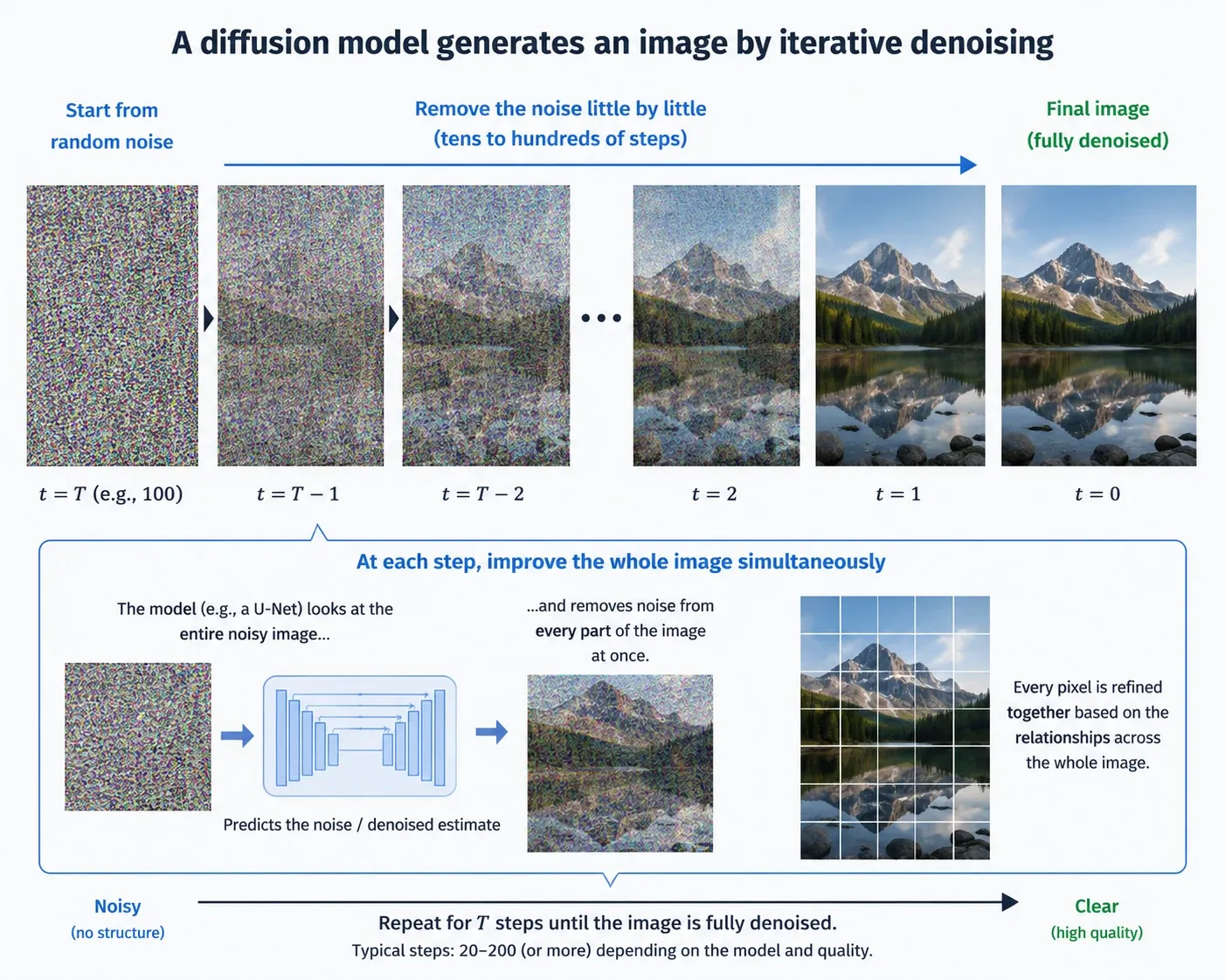
A diffusion model generates an image by iterative denoising.
- Start from random noise
- Remove the noise little by little (tens to hundreds of steps)
- At each step, improve the whole image simultaneously
Because it processes the whole image in parallel, its strength is global coherence (overall composition and balance).
Autoregressive models (gpt-image-1)
Meanwhile, gpt-image-1 is an autoregressive model. It generates images by exactly the same principle as GPT generating text, predicting the next token, with no denoising involved at all.
In other words, it applies the same approach as LLM text generation to images.
| Property | Diffusion | Autoregressive |
|---|---|---|
| Generation process | Noise → iterative removal → image | Generate tokens one at a time, sequentially |
| Parallelism | High (whole image processed at once) | Low (sequential) |
| Text rendering | Weak (historically) | Strong (tokens = text’s home turf) |
| Instruction-following | Weak | Strong (same model as text understanding) |
| Image quality | High (artistic expression) | Improving (solved by scale) |
The discrete-vs-continuous wall that split the two approaches
Behind the existence of these two approaches is a difference in the nature of the data.
- Images = continuous data. Randomly change 10% of a cat photo’s pixels and it still looks like a cat. It can transition smoothly from “complete noise” to “a sharp image”
- Text = discrete data. Add 10% noise to the word
CATand it does not become a “blurry cat”. It becomes a different wordHATor a meaningless string
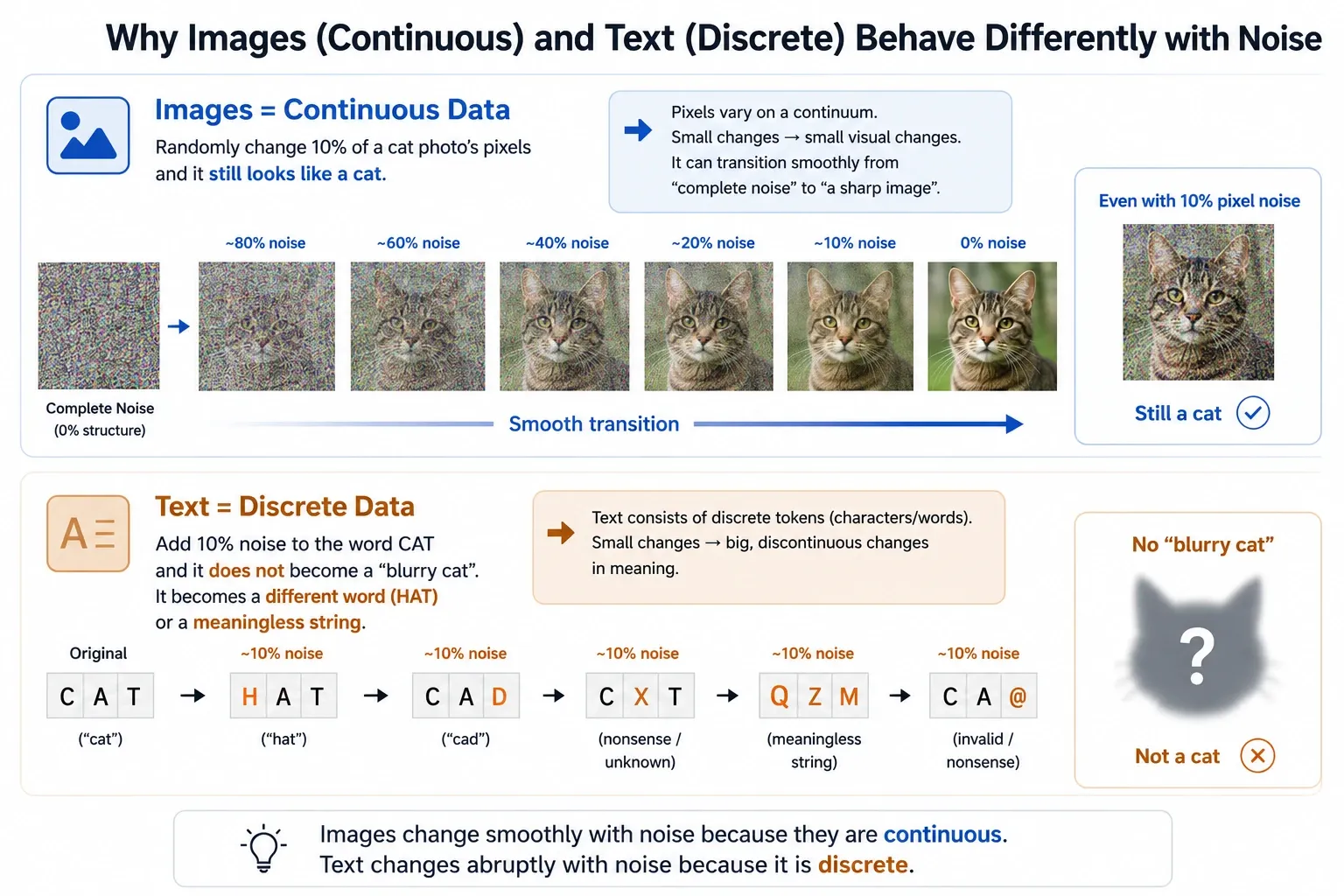
This “continuous vs discrete” wall produced the division of labour: diffusion for images, autoregressive for text. And the reason an autoregressive model converts an image into tokens (discrete units) before generating is precisely a strategy to get over this wall.
Why is diffusion bad at text rendering?
Have you seen the phenomenon where letters break down in AI-generated images? To a diffusion model, letters in an image are just visual shapes. When it denoises “EXIT”, it does not understand E-X-I-T as four letters; it tries to draw four independent geometric shapes. If pixels shift slightly at an intermediate step, even when “E” morphs into “F”, the model feels no visual problem.
An autoregressive model, by contrast, generates images in the same token space as text, so it can render while preserving the letters’ “meaning”. The “text rendering” difference in the comparison table comes from this structural difference.
How does an autoregressive model generate an image?
Being told “it makes images the same way as text” may not click. Look at the concrete flow.
Step 1: tokenise the image
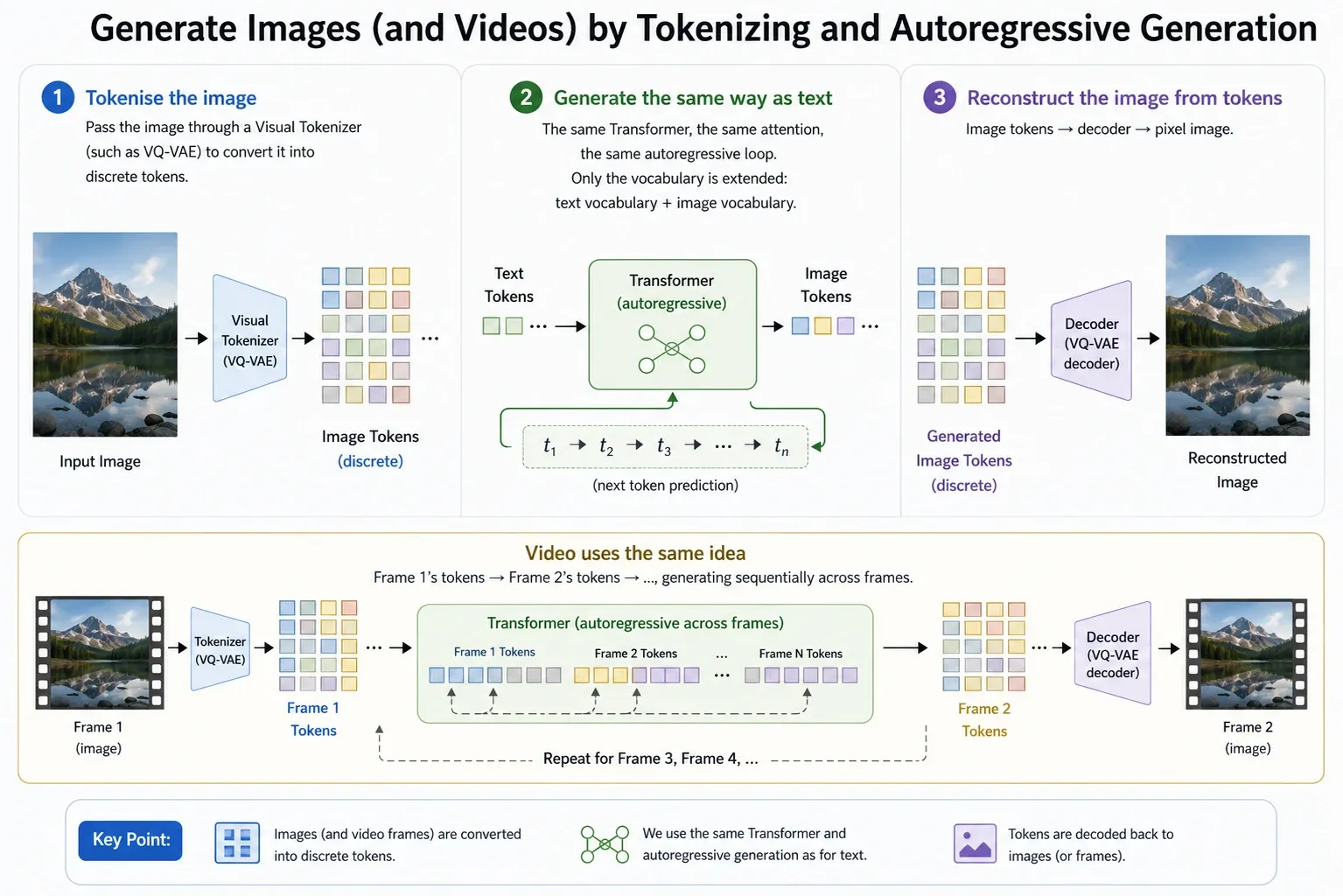
Pass the image through a Visual Tokenizer (such as VQ-VAE) to convert it into discrete tokens.
- Example: a 256×256 image → about 1,024 tokens
- Each token = a small patch (region) of the image
- Mapped to a codebook (the image version of a “vocabulary”)
Step 2: generate the same way as text
[text tokens] → [image token 1] → [image token 2] → ... → [image token N] ↑ predicted from ↑ from text + ↑ from all preceding text token 1 tokensThe same Transformer, the same attention, the same autoregressive loop. Only the vocabulary is extended: text vocabulary + image vocabulary.
Step 3: reconstruct the image from tokens
image tokens → decoder → pixel image
Video uses the same idea: frame 1’s tokens → frame 2’s tokens → …, generating sequentially across frames.
The sculptor and the 3D printer
These two approaches can, in fact, be understood in one shot with familiar things.
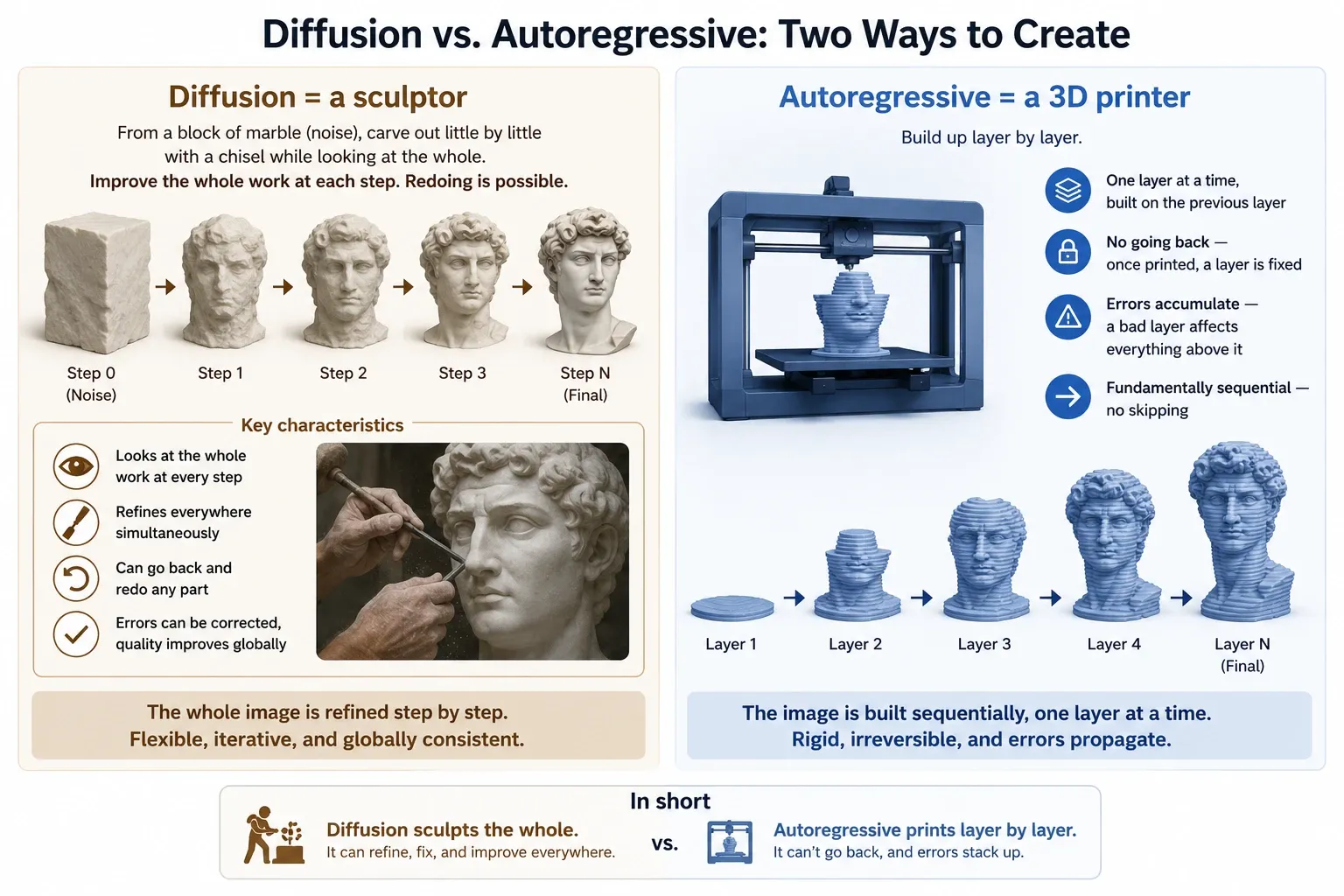
Diffusion = a sculptor
From a block of marble (noise), carve out little by little with a chisel while looking at the whole. Improve the whole work at each step. Redoing is possible.
Autoregressive = a 3D printer
Build up layer by layer.
- One layer at a time, built on the previous layer
- No going back: once printed, a layer is fixed
- Errors accumulate: a bad layer affects everything above it
- Fundamentally sequential: no skipping
A 3D printer cannot. This exactly matches the autoregressive constraint that “once output, you cannot go back”.
The error-accumulation problem, and why OpenAI accepted it
Some noticed it from the 3D-printer analogy. Autoregressive models have an essential weakness of error accumulation. If a previous step is wrong, it propagates to everything after.
So why did OpenAI adopt this approach?
Possible reasons:
- Unified architecture: text and images are processed by the same model. The scaling story becomes simple
- Prioritising instruction-following: because text understanding and image generation are in the same space, fidelity to the prompt is high
- Mitigation by large-scale training: error accumulation is a theoretical weakness, but with enough scale and training technique it can be suppressed to a practical level
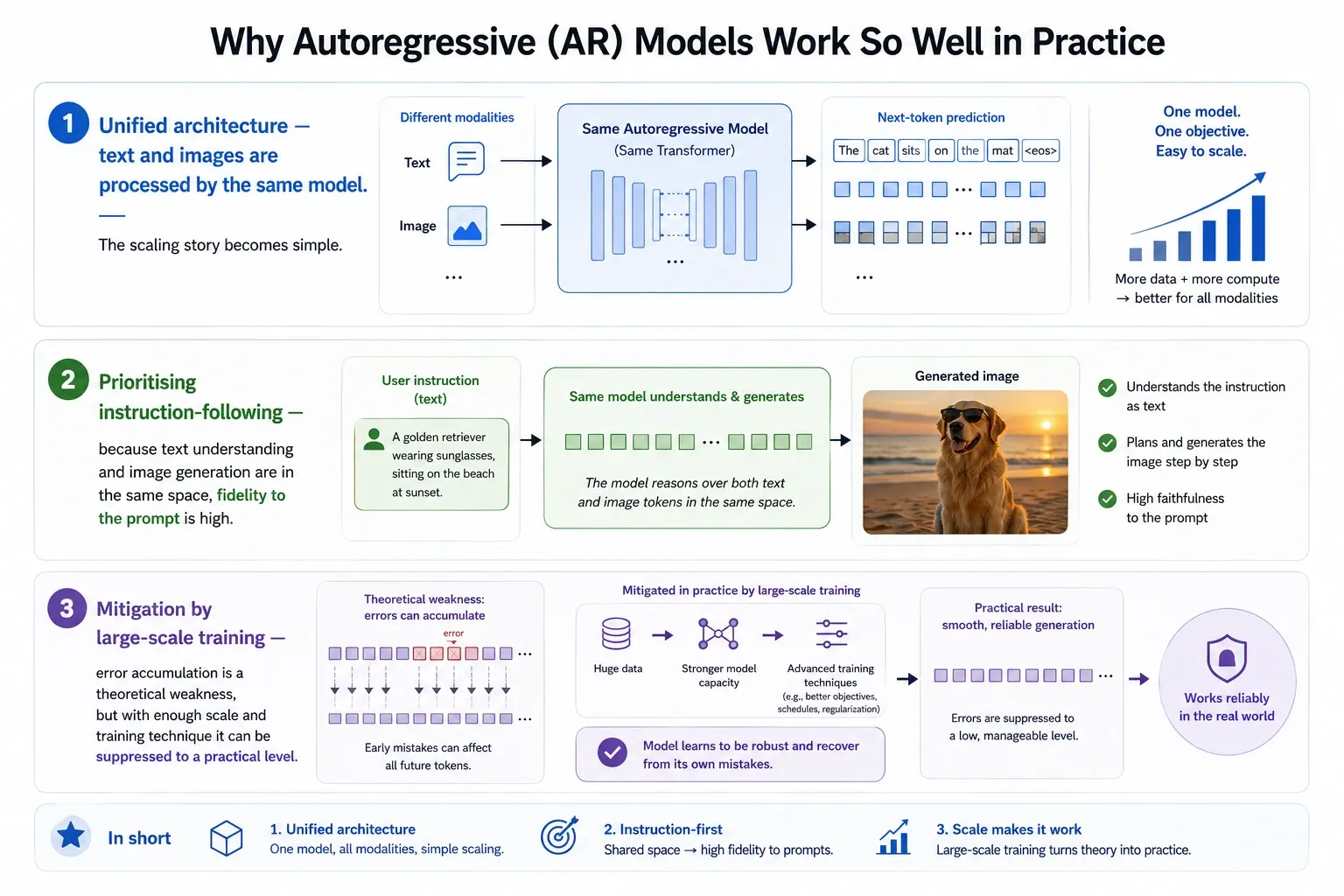
Much of the industry considers “a Transformer-diffusion hybrid (DiT: Diffusion Transformer)” the best, but OpenAI deliberately chose the pure autoregressive line.
Self-correction with reasoning
A question arises here. Just as an LLM raised text quality by “thinking before answering”, can image generation “think while drawing”?
In fact this is becoming exactly the autoregressive model’s structural strength. GPT Image 2 (April 2026) introducing a reasoning model into image generation is the first step in this direction.
Possible approaches
1. Planning tokens: design before drawing
Before generating image tokens, “think” about composition, layout, and colour design in text reasoning tokens. Like a 3D printer scrutinising the blueprint before printing, prevent mistakes in advance.
2. Interleaved reasoning: think while drawing
[reasoning: plan composition] → [image token group 1] → [reasoning: face proportions are off, adjust] → [image token group 2] → ...Alternate text reasoning and image generation, correcting course midway.
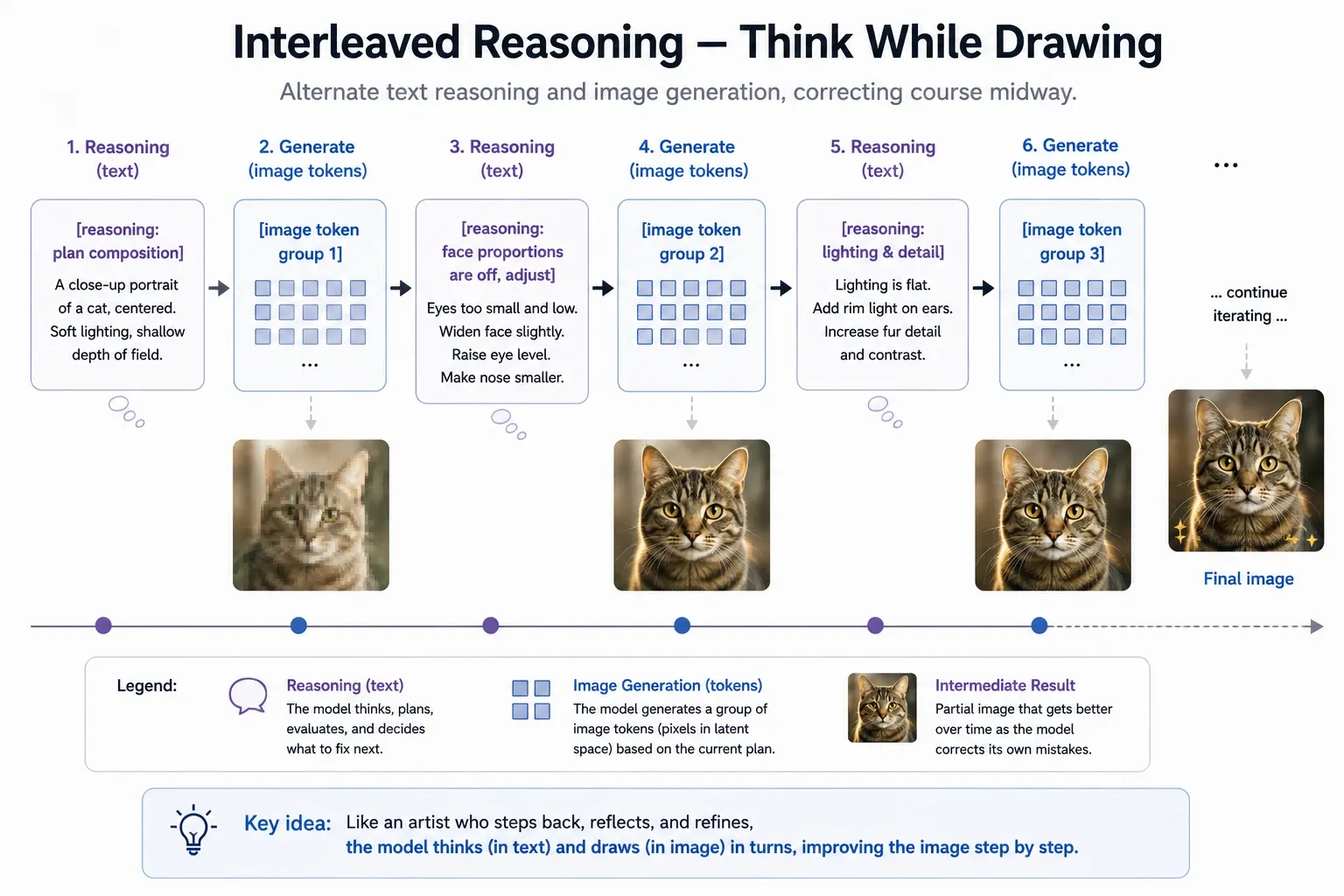
3. Generate → critique → regenerate: review after drawing
The same model evaluates the finished image and regenerates if there is a problem. Precisely because of the unified architecture, “self-critique” of the image happens naturally.
Why is this a structural advantage of AR?
This is the important point. Self-correction via reasoning is an advantage inherent to autoregressive models.
- AR models share the same reasoning machinery as LLMs. Chain-of-thought, self-critique, and planning are native abilities
- Diffusion models operate in a continuous latent space, so there is no natural place to insert a “thinking” step
- The unified architecture lets it reason about image composition with the same attention machinery it uses to reason about text
Extending the 3D-printer analogy: a 3D printer that pauses before printing each layer, inspects the work so far, and adjusts the remaining blueprint. It does not make the error-accumulation problem disappear, but it greatly mitigates it.
DiT (Diffusion Transformer), the third option
We have looked closely at diffusion and autoregressive, but in fact the most widely adopted architecture in 2026 image generation is neither: DiT (Diffusion Transformer). Sora, Stable Diffusion 3, Flux and Imagen 3 all adopt it.
The limits of U-Net
Conventional diffusion models (DALL-E 2, Stable Diffusion 1.x/2.x) used a CNN-based architecture called U-Net at the core of the denoising step. U-Net is excellent at image processing but had two limits:
- The scaling wall: increasing parameters tends to plateau in performance
- Weak global-context understanding: CNNs are strong at local pattern recognition but bad at capturing the semantic coherence of the whole image
DiT’s idea: swap the “engine” of denoising
DiT’s idea is simple. Keep the diffusion generation process (noise → iterative removal → image) as-is, and replace the neural network that denoises at each step from U-Net to a Transformer.
Conventional diffusion: noisy image → [U-Net] → slightly cleaner → [U-Net] → ... → finished imageDiT: noisy image → [Transformer] → slightly cleaner → [Transformer] → ... → finished imageThe generation principle is the same “sculptor” method. But the image is: instead of a chisel, it now carves with a more precise tool.
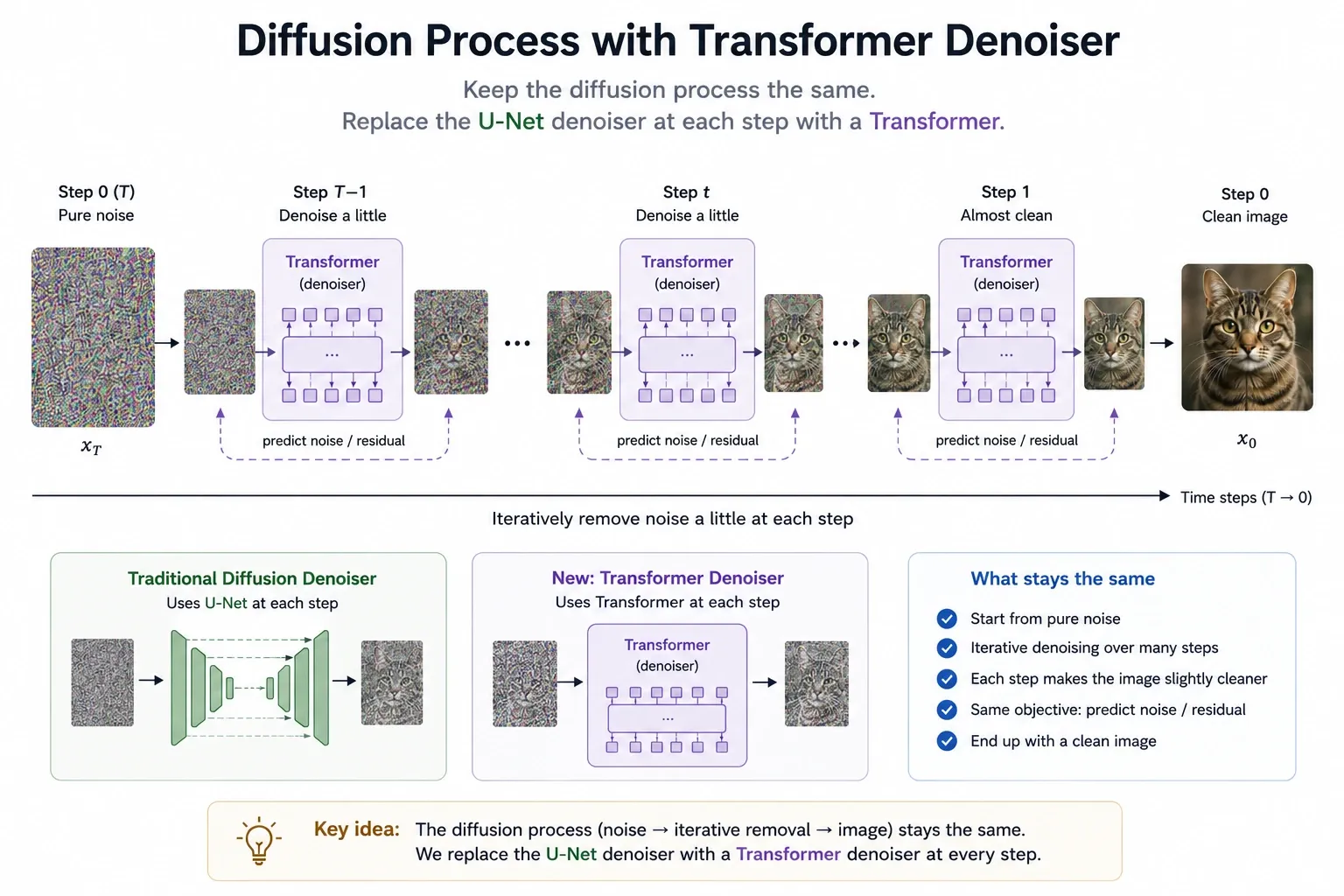
Why replace it with a Transformer?
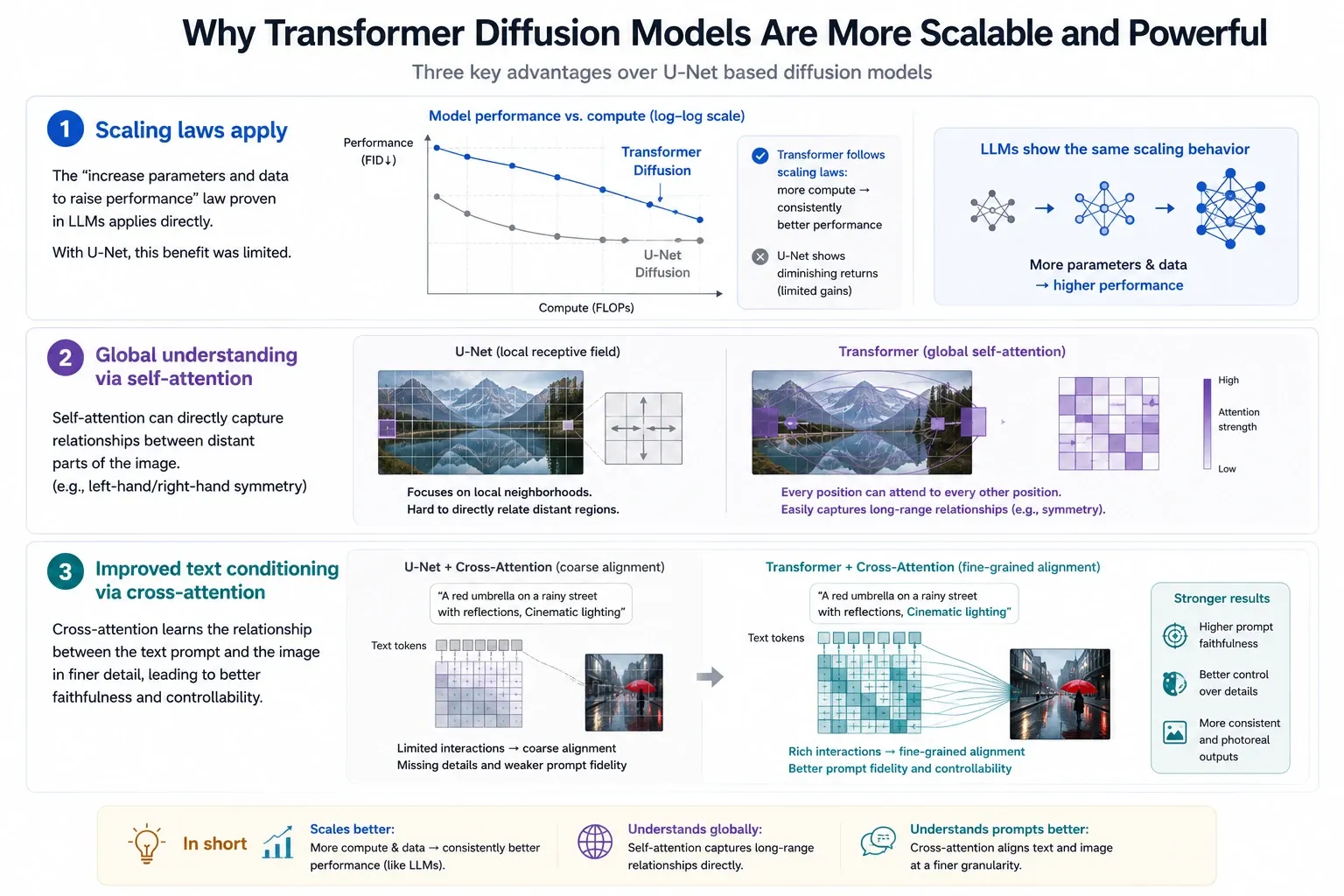
Swapping to a Transformer brings three advantages:
- Scaling laws apply: the “increase parameters and data to raise performance” law proven in LLMs applies directly. With U-Net this benefit was limited
- Global understanding via self-attention: it can directly capture relationships between distant parts of the image (e.g. left-hand/right-hand symmetry)
- Improved text conditioning: cross-attention learns the relationship between the text prompt and the image in finer detail
Is DiT a “hybrid”?
Strictly, DiT is a pure diffusion model. Its generation process is iterative denoising, not sequential token generation. But because it uses a Transformer inside, it receives the same scaling benefit as AR models.
It is called a “hybrid” because it combines diffusion’s generation philosophy + the Transformer’s scaling ability.
The 2026 market, and its three competing approaches
Pure autoregressive (the OpenAI camp)
A large commercial success.
- GPT Image 1 launch week: over 700 million images generated, over 130 million users
- GPT Image 1.5 (December 2025): 1st on the Arena text-to-image leaderboard (ELO 1264, 29 points ahead of 2nd)
- GPT Image 2 (April 2026): introduced a reasoning model into image generation
- Many startups migrated from diffusion servers to the OpenAI API
Pure diffusion (the open-source camp)
Still going strong.
- Open-source models like Flux and Stable Diffusion 3 are active
- The artist community supports diffusion for fine aesthetic control
- The fine-tuning and LoRA ecosystem is mature
Hybrid DiT (academia and emerging forces)
The research frontier.
- The DiT (Diffusion Transformer) architecture: adopted by SD3, Flux, Sora, Imagen 3
- MIT research: capture rough structure with AR and finish detail with a small diffusion model → 9× speedup at comparable quality
- Combines the Transformer’s global understanding + diffusion’s image quality
| Approach | Strengths | Weaknesses | Representative examples |
|---|---|---|---|
| Pure AR | Instruction-following, text rendering, unified model | Error accumulation, historically inferior quality | GPT Image 1/1.5/2 |
| Pure diffusion | Image quality, artistic control, OSS | Speed, weak text rendering | Midjourney, SD3, Flux |
| Hybrid DiT | Both speed and quality | Architectural complexity | Sora, Imagen 3, SD3 |
Not “one dominant” but “three kingdoms”
As of 2026, there is no sign diffusion is being abandoned. Rather, the three approaches coexist, each in its own domain.
- Product/UX focus → autoregressive (OpenAI)
- Open source/art → diffusion
- Research/performance optimisation → hybrid DiT
What lies beyond: denoising thought
I have said “text is discrete, so diffusion is unsuited”, but there is one interesting perspective. The human thought process itself is continuous and noisy.
Before writing, the brain does not hold a clear token sequence. It holds a “vague cloud” of concepts, emotions, and spatial relationships, gradually crystallising it and settling it into structured language. This closely resembles a denoising process.
Researchers are already moving in this direction. Instead of adding noise directly to text tokens, an approach called Embedding Diffusion is being experimented with, which denoises a “thought vector” from random noise in the vector embedding space and converts the finished thought vector into text with a decoder. Meta’s Yann LeCun’s proposed I-JEPA (Joint Embedding Predictive Architecture) also aims at predicting and refining abstract concepts in a continuous space, the same direction.
The AR-vs-diffusion rivalry may not end at the 2026 “three kingdoms”. Denoise an idea in a continuous thought space, then convert it to language or images. Such a fourth paradigm may be waiting ahead.
Summary
- The difference between gpt-image-1 and DALL-E 3 is the fundamental architectural difference of autoregressive (sequential token generation) vs diffusion (iterative denoising)
- Underlying this divergence is a mathematical wall of “continuous vs discrete data”. An AR model tokenising images is a strategy to get over this wall
- Autoregressive tokenises images and generates them the same way as an LLM. Like a 3D printer it builds up layer by layer and cannot go back
- Diffusion is bad at text rendering because it treats letters as “shapes”, not “meaning”. An AR model solves this by sharing the token space
- It has the theoretical weakness of error accumulation, but a solution inherent to AR models is emerging: self-correction via reasoning (think before drawing, correct course while drawing)
- The 2026 market is a three-way contest of “AR vs diffusion vs hybrid”. Rather than one disappearing, use-case-based division of labour is advancing
- Beyond that, a possible “fourth paradigm” is coming into view: denoise an idea in a continuous thought space, then convert it to output